I’m from Brittany, in western France, and as a Breton, the crêpe is one of my region’s great culinary points of pride. In this article I’ll tell you its history and share my recipe.
A 7,000-year-old story
Before bread, before the oven, humanity was already cooking flat batters. The first “crêpes” date back to roughly 7,000 BC, when prehistoric peoples mixed ground grains with water and cooked them on hot stones. A universal recipe repeated all over the world: the tortilla in Guatemala, injera in Ethiopia, blini in Russia, or baghrir in the Maghreb.
But the crêpe as we know it today has its richest history in my home region: Brittany, in western France.
13th century
Crusaders return from Asia bringing sarrasin (buckwheat), a hardy grain that grows well in Brittany’s poor soil. From it, the Breton galette is born: dark, thick, and full-flavored, cooked on a flat stone.
15th – 16th centuries
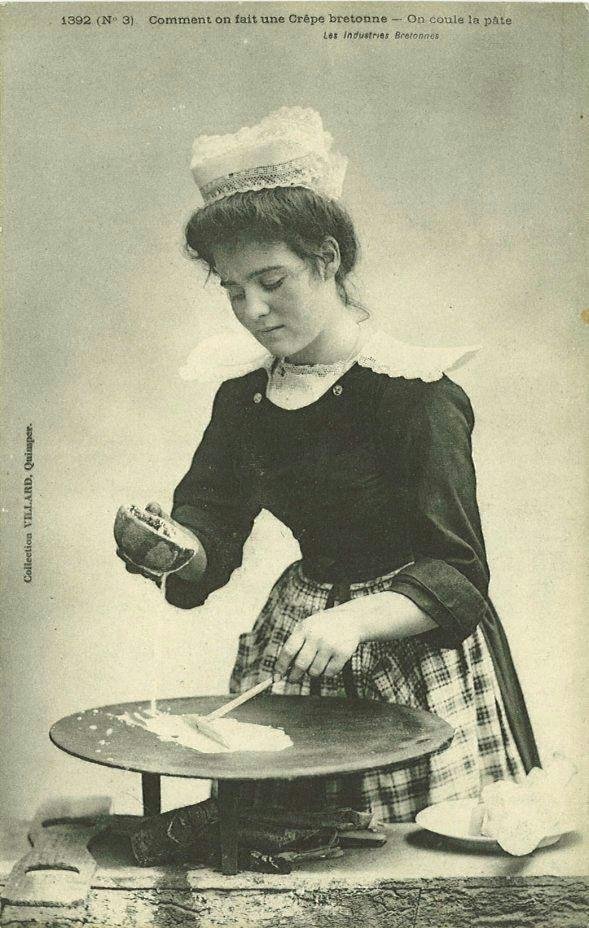
Buckwheat becomes the staple food of Breton peasants. Families would make crêpes at least once a week on an iron griddle called a billig, spreading the batter with a rozell (crêpe spreader). It was the poor man’s dish: nutritious, filling and cheap.
19th century
Thanks to falling prices for white wheat, the sweet crêpe made with milk and eggs is born — the one we know today. Bretons migrate to Paris and open the first crêperies. The crêpe conquers all of France.
20th century – today
More than 4,000 crêperies in France. The crêpe becomes a global culinary symbol. The famous Crêpe Suzette, flambéed with orange liqueur, was born almost by accident on the Côte d’Azur and became legendary.
A Breton woman making crêpes, circa 1900.
“
Tradition says you have to flip the crêpe in the air with your right hand while holding a gold coin in your left. If it lands well back in the pan, it will bring prosperity and a good harvest all year long.
Crêpe or Galette? Not the same thing
The crêpe is made with white flour, milk and eggs. Thin, soft, and served sweet: sugar, butter, jam, Nutella, salted caramel.
The galette is made with buckwheat flour, water and salt. It’s darker in color, and filled with savory ingredients: ham, cheese, egg.
My crêpe recipe
Servings 15 crêpes
Prep 10 min
Resting 30–60 min
Cooking ~1 min each
Ingredients
300 g white wheat flour
3 large eggs
600 ml whole milk (room temp.)
1 pinch of salt
3 tbsp sugar (for sweet crêpes)
60 g melted butter
1 tsp vanilla or rum (optional)
as needed butter for the pan
Step-by-step preparation
1
Sift the flour
In a large bowl, sift the flour with the salt and sugar. Make a well in the center — this step is key to avoiding lumps from the start.
2
Add the eggs
Crack the 3 eggs into the well. Using a whisk, mix from the center outward, gradually pulling in the flour from the edges.
💡 If lumps form, strain the batter at the end through a fine sieve.
3
Add the milk gradually
Pour in the milk in a thin stream while continuing to whisk. Add half first, whisk well until smooth, then the rest. The batter should end up as fluid as thin cream.
4
Add butter and flavoring
Add the melted butter (once cooled) and the vanilla or rum. The butter is the secret to keeping the crêpes from sticking, and makes them soft and glossy.
5
Let the batter rest — the most important step!
Cover the bowl and let it rest at room temperature for at least 30 minutes (ideally 1 hour, or overnight in the fridge).
💡 Resting relaxes the gluten and lets the flour fully absorb the liquid. A rested batter means much softer, more elastic crêpes.
6
Heat the pan
Use a 22–26 cm nonstick pan. Heat it over medium-high heat. Grease it with a little butter using folded paper towel. The right moment: when the batter forms small bubbles as it touches the pan.
7
Pour and spread the batter
Pour ~60 ml into the center of the pan. Immediately lift it and swirl it in circular motions to cover the whole surface within 3-4 seconds. The crêpe should end up almost translucent.
💡 The first 1 or 2 crêpes usually come out imperfect — that’s completely normal. In France they say the first one “is for the dog.”
8
Cook and flip
Cook for ~1 minute, until the edges turn golden and lift on their own. Flip with a thin spatula. Cook the other side for just 30 more seconds.
9
Stack and serve
Stack the crêpes; they won’t stick together. Cover them with a clean cloth to keep them warm while you finish the rest. Re-grease the pan every 2–3 crêpes as needed.
How to serve them?
🧈
French classic Melted butter and granulated sugar. Simple, classic and delicious.
🍫
House sweet Nutella or dark chocolate + sliced banana + chopped walnuts. A classic that wins everyone over.
🍓
With fruit Whipped cream + strawberries, mango, passion fruit or blackberries. With Guatemalan fruit, this version is perfect.
🧀
Savory “La Complète” Ham + melted cheese + a fried egg on top. You can also add caramelized onion 😋




Aún no hay comentarios